
If we look at the list of top challenges that the U.S. healthcare industry is grappling with at present, then a shortage of staff and employee burnout rank right at the top. At the same time, rising labor costs, drug prices, and inflation have contributed to hospitals experiencing declining margins.
The result?
Most healthcare institutions find it challenging to handle common support tasks like answering calls. In case you are wondering, yes, a missed call is an important metric. Because every call that is not answered or is hastily answered without the care it deserves leads to poor patient satisfaction, delayed care, and potential loss of revenue opportunities. Moreover, missed calls reflect operational inefficiency and create a bad image of the facility in the minds of people.
But rising labor costs, lack of quality manpower availability, and declining margins mean hiring additional manpower is not a viable solution.
The solution?
Using automated medical answering services. AI-powered automated answering services help healthcare facilities offer 24/7 coverage while instantly addressing patient inquiries and eliminating voicemails or long hold times. Along with reducing missed calls, these systems capture after-hour requests, handle high volumes simultaneously, schedule appointments, and route urgent calls to appropriate staff.
How Automated Medical Answering Services Improve Patient Care
The most common concern about automation is that it will replace humans. However, this concern is totally unfounded because, instead of replacing the personal touch of healthcare, automation actually enhances it. While automated medical answering services handle the mundane tasks, your employees are able to do more and offer better care.
Reduced Response Times
With an automated answering service, your patients need not be stuck on hold or go through endless back-and-forth calls to submit their request. Instead, they can use the automated intake to directly submit their messages digitally. Automated medical answering services, therefore, result in faster message handling, earlier interventions, and better patient outcomes.
Improved Accuracy and Completeness
Automation reduces human error by guiding patients through a structured, adaptive intake process. For example, if a patient types a note for chest tightness, the automated intake forms prompt for related symptoms like dizziness or shortness of breath. The detailed and precise responses mean that doctors receive comprehensive and relevant information regarding patients. This minimizes the need for follow-up clarification and expedites the treatment process.
24/7 Accessibility
Patients can use automated medical answering services to report symptoms even after working hours without waiting for callbacks. If you pair this with outsourced nurse triage, then patients will always have someone available to address their needs, evaluate their symptoms, and guide them to the care they need before your office opens the next day.
Strengthening Continuity of Care
Automation, when compatible with existing electronic health record systems, supports better coordination across care teams. This makes it easier for administrators, physicians, and nurses to stay aligned on the needs and history of each patient.
Benefits for Doctors and Clinical Teams

The physicians and nurses at your healthcare facility are hard-pressed for time, and an automated answering service for small businesses can be a boon for them. Why? Because an automated answering service handles all incoming calls and allows patients to directly submit their messages digitally, healthcare professionals spend less time sifting through voicemails, clarifying incomplete messages, or following up with patients for updates.
With an automated answering service, doctors receive structured and accurate summaries of patient concerns, thus saving 3–7 minutes per patient intake request. This might not sound like much, but for a busy clinic handling about 50 patients each day, it translates into saving hours of clinical time per week. It implies that doctors would now have more time for tasks like offering better patient care, education, or charting reviews.
There are clear benefits for nurses as well. Because automated answering services mean clear and complete patient messages, it reduces the need for repetitive follow-ups and manual data entry. This results in improved staff productivity, increased patient satisfaction, and better documentation accuracy-key parameters of operational success.
Enhancing the Patient Experience
As a healthcare service provider, you are not just competing with your peer group but with other digital service providers as well. Therefore, while interacting with your institution, your consumers would compare and expect the same level of convenience that they receive from other digital services. Automated medical answering services help you bridge this expectation gap.
By allowing patients to describe their symptoms at their own pace, in their own words, without waiting on hold, automated answering services reduce their anxiety and ensure that they feel heard. The system also ensures that incoming messages are prioritized based on urgency, meaning patients with more serious needs receive responses and care earlier.
The result?
Providers can maintain a consistent and improved standard of care, and patients have a better experience, resulting in stronger engagement and trust.
Security, Compliance, and Peace of Mind
Data security is a top concern for every healthcare organization. And a manual answering system with human touch points increases the chances of data exposure and transcription errors. However, Automation Expert’s automated medical answering services are HIPAA compliant and use cloud security, encrypted communication, and access controls to protect sensitive health information.
Moreover, automated answering services reduce the number of human touch points in the message-handling process, thereby minimizing the opportunities for transcription errors and data exposure.
The Real-World Impact of Using an Automated Answering Service
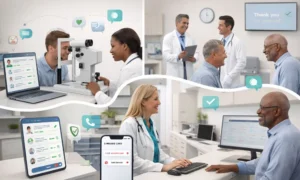
Healthcare organizations using automated answering services can see significant improvements in patient satisfaction and operational efficiency within a short period of time. In some cases, healthcare organizations have seen up to a 60% reduction in manual message intake within weeks of implementing automated medical answering services.
These measurable results show that automation can elevate both operational performance and patient care while freeing up staff, reducing burnout among caregivers, improving documentation, reducing follow-ups, and allowing doctors to focus on delivering high-quality care.
Moreover, Automation Expert’s automated answering services can integrate with established workflows like EHR and nurse triage. Whether your business needs supplemental support or full automation, we can adapt to your patient needs and call volume to give your staff the freedom to focus on providing quality care.
Final Words
As discussed during the opening section, a shortage of staff and employee burnout are already top concerns bothering the American healthcare industry. The problem will likely compound over the coming years as a large section of the population, comprising baby boomers, enters old age.
As such, the industry urgently needs technological interventions in the form of AI and automation to solve the crisis. Given these circumstances, automated medical answering services can prove to be invaluable for every healthcare organization. Automated answering services can reduce the work burden on healthcare staff, giving them more time to deliver quality care.
At the same time, automated answering services can reduce patient wait times and improve the experience patients have while interacting with your organization. The result is improved care, high operational efficiency, and a better reputation for your organization.
If this sounds interesting and you would like to explore further, connect with an Automation Expert today. We have helped many healthcare organizations leverage the benefits that automation offers, and you could be next.